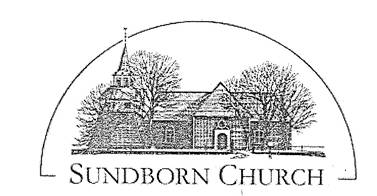
In 1632 a Church was erected in Sundborn, in the same place that the present Church resides, which is by lake Toftan and where the Sundborn River begins. The first Church was a rectangular building with its vestry at the northern end and with the entrance to the south.
At the same time a minister was appointed to serve in Sundborn. In those days Sundborn was an annex to the parish of Svärdsjö and the local people in Sundborn had to travel there to receive all the services that the Church provided. In 1636 Sundborn was established as a parish in its own right.
In 1755 the original Church building was taken down and the present Church was erected on the same location, using the traditional method in which horizontal logs are "knitted" together, and the new temple formed a cross. The new vestry was added on behind the altar and at the western end the tiny ante-room ("weapon store" in Swedish, because people were asked to take off their weapons before entering the Church) found its proper place.
The outer walls were shingled and painted red with the local “Falu rödfärg.” The roof was also clad in shingle and tarred although not painted. The interior of the Church gives an impression of lightness and simplicity, the white, vaulted ceiling adds space and the fittings are nice and sill1ple. Some of the fittings from the former church were used in the ne\v. The Font, of brown lime-stone, dates from 1659, one of the chandeliers dates from 1682 and various pews are also from this era.
The Altar piece was painted in 1820 by an unknown artist. The Altar itself, the gable and the front columns are made of wood. The painting gives an image of an ancient Greek temple, and the artist uses the perspective-technique to create a sense of depth and reality. In this Greek temple the artist has placed a symbol of the Resurrection. Before this piece of art was put in place, the oil painting now hanging on the north wall (Christ at Getsemane) was used as an Altar decoration.
The Pulpit on the wall was put in place in 1873. The smaller one, on the floor, is made of timber from the previous Church, which was found during a recent restoration. The same applies to an altar table, which is now kept in the vestry.
The Hymn-number boards are made of wood, the ornate one on the wall was donated to the Church in 1756. As early as 1628 there was an organ in the Church. The organ has been upgraded and rebuilt several times. The last time being in 1908 by Gunnar Setterquist. The front is white and gold, and was made sometime during the 18th century.
In 1905 Carl Larsson left his mark on the Church when his eldest son Ulf died and Carl Larsson had some difficulties with his works. So he offered to redecorate the Church for no charge. In a letter written by Karin Larsson to her mother on the 21st of July 1905 we can read: "Carl is right now redecorating our Church. There will be flowers and garlands, pigeons and angels and there will be festivities and joy. It will be inaugurated on the last Sunday in August. Edith Anjou and Lisbeth will then be wearing the dress of Sundborn." There were the two girls who posed as models for the two angels that are: kneeling in front of the Holy Ghost, which is symbolized by a dove. This is to be seen above the altarpiece with a bright blue sky as a background. In order to increase the sense of depth a shadow was added around the altarpiece. Above the doors leading into the vestry, yellow and white lilies where painted. On the opposite side above the organ you can see a representation of creeping flowers around the vaulted ceiling. There is also a sort of flower garland painted on the gallery of the organ. Above the chandeliers, on a red background, there is honeysuckle. In the middle of the roof there is an ornament of leaves. The leaves are from a chestnut tree, a lime tree, and an elm tree. On the north and south walls, pine shoots were painted like the footprints of a bird. Above the pews Carl Larsson painted flowers, woven into a grid, so as to embrace the altar. The Church walls have an edge of white flowers on red.
Above the south door C.L. wrote "Cud aliena äran" (Soli Deo gloria) and surrounded it with stylised rosebuds.
The walls and the pews are in the original colours and it was the surrounding forest and the blue water that inspired this choice of colours.
C.L. made a rnemo about the church in his book Spadarfvet "I have painted small modest flower motives here and there, I hope they will contribute to the homeliness."
In 1910 Carl Fredrik Petterson, the vicar of Sundborn, turned 80 years old and he had always wanted a painting of John the Baptist, his personal favourite character from the Bible. On the 20th of June Carl Larsson surprised him with the painting you can now see above the northern window:
Above the door, on the outside of the Church, there are two sunflowers to welcome the visitors.
The little white funeral Chapel by the shore of lake Toftan was built in the early 19th century. It was probably not a coincidence that it was built in the same style as the altarpiece. Inside Carl Larsson’s has decorated the walls beautifully in grey with black flower garlands. On the eastern wall, Heaven is waiting with its angels and they are looking down upon the arriving souls. Behind a cross you can see a shining light. Carl Larsson’s words above the door are: "Lord, teach me how to handle the fact that I have to die."
The bell tower was built in 1706 and it is built in the same style as the Church. Red shingles covering the lower part, with gables in white and shutters in black tar. Behind them therc arc three bells, which were cast during the 17th century, but all had to be recast later.